Perimenopause · The thing no one warned you about
No one warned me perimenopause would show up on my face first.
You eat well. You move. You’ve done the things. So why does the woman in the mirror look like she’s holding a whole day’s worth of water — and why does no one tell you the real reason?
There’s a specific morning a lot of women remember.
You’re getting ready, you glance in the mirror, and the face looking back isn’t quite yours. The eyes are half-shut with puff. The jawline you’ve had your whole life has gone soft, like someone pressed a thumb into clay. By eight that night your waistband is digging in, your rings won’t slide off, and your stomach looks like you swallowed the whole day.
And here’s the part that stings: you didn’t do anything different. Same food. Same walks. Same you. For the first time in your life, even a good diet and working out isn’t helping — and somewhere quiet, you’ve started to wonder if you just… let yourself go.
You didn’t. That’s the whole reason this page exists. What you’re seeing in the mirror has a cause, the cause has a name, and once you hear it you can stop blaming yourself and start doing the one thing that actually fits the problem.
Already know this is you, and you just want to see what’s working? See the product with the four herbs →
I’m Sarah. I’m not a doctor, and I won’t pretend to be one. I started looking into all of this the year my mum turned fifty-one and asked me to delete a photo from a family wedding. “I don’t recognize her,” she said — not the dress, the face. A round, water-heavy face that had arrived, seemingly overnight, on a woman who ate well and walked every morning. Her doctor told her the thing every woman in this story gets told: lose ten pounds, cut the salt, it’s just your age. It wasn’t the salt. The scale had barely moved. Something else had. So I went looking.
If you’ve lived this, you already know the small humiliations no one warns you about.
The rings. You twist them, you soap them, and some mornings you just leave them on the dresser. The photos you quietly delete. The “you look tired” from someone who means well and has no idea. And the part that catches a lot of women off guard: you are not imagining this, and you are not the only one. Go into the threads where women 45 to 58 actually compare notes and it’s all there. One woman on Reddit wrote that someone said “look at that lymphatic system” about her — and her reaction was, so where exactly on my body am I supposed to be ashamed of that?
And underneath all of it, the worst part: the effort that goes nowhere. You cut the wine. You added the steps. You did a “cleanse” that lived in the bathroom for three days. And the puffiness didn’t care. One woman in those same threads put it the way a lot of you feel it:
“For the first time in my life, even a good diet and working out isn’t helping.”
Another said she felt like “a stagnant body of water all the time.”
Here’s what I need you to hear before we go one inch further: this is not a willpower problem. It is not ten pounds. It is not the wine, or the second helping, or anything you did. The body that showed up at fifty isn’t proof that you stopped trying. It’s proof that something changed — and it changed on a schedule you never got to pick.
So what changed?
Your body has a drainage system. Picture it like a tide. Twice a day, fluid is supposed to move out of your tissues and out of your body, carried along on a current. When the current is strong, the tide goes out, and you feel light. When the current goes slack, the water just sits. It pools. And it pools first where your skin is thinnest — your face, your eyes, your jaw — and shows up last where you mind it most: the belly that balloons by night, the rings that won’t budge.
So what makes the current go slack? Estrogen was part of what kept it strong. Estrogen helps hold the tone in the vessels that move that fluid. When estrogen falls in perimenopause, that tone weakens — and the tide that used to clear your body every day starts to stall. The fluid that always moved out before now stays.
That’s the cause. We call it The Estrogen Drainage Stall.
Once you can see it, the pieces fall into place:
- It explains the “why now.” You didn’t change your diet. Your hormones changed. (One woman on Reddit, watching a total stranger describe this exact problem, told her flatly: “You’re probably approaching perimenopause, I would get hormones checked.”)
- It explains why it’s worse by evening. A slack tide pools more the longer you’re upright. Morning face, evening belly — same stall, different hours.
- It even explains the thing people complain about when something finally starts working: you’ll visit the bathroom more at first. That’s not a side effect to dread. That’s the tide going back out.
And here’s the quiet tell that this isn’t something we made up to sell you a bottle: once you know to look for the timeline — the change that arrived with the hormones, not with the diet — you start seeing the same story everywhere women our age talk honestly about their bodies. You were never the only one. You just hadn’t been handed the word for it.
One honest note, because you’ve earned it: the link between estrogen and how your drainage moves is a traditional, directional idea — a way to understand what you’re feeling, not a medical diagnosis. These drops support your body’s natural lymphatic flow. They are not a treatment for any medical condition.
Which raises the obvious question. If a stalled tide is the real problem — why didn’t anything you already tried fix it?
Want to skip ahead and just see the four herbs? They’re right here →
Because none of it was ever aiming at the tide.
The water pill your doctor handed you strips water out — you peed all day and felt like a dried husk by three — but it never touched the current. It treats the puddle, not the pipe. Compression squeezes the fluid somewhere else, and the second it’s off, it’s back; nobody wants to wear surgical hosiery to book club at fifty-two anyway. Cutting salt? A month of bland, sad food and you still woke up puffy, because salt was never the current. And the twenty-six-herb “detox” drop with the impressive label? Twenty-six ingredients means there’s barely a real dose of any single one — you’d been taking it for ages and quietly wondered if there was ever enough of anything in there to matter.
Every one of those does something to fluid. Not one of them restarts the drainage at the vessel — which is the only thing that touches a stall. That’s the gap. And it’s the gap a small, deliberately simple approach was built to fill: The 4-Herb Vessel Drainage Method.
The idea is almost old-fashioned. Long before water pills, herbalists reached for a short list of plants to get stuck fluid moving — and four of them keep showing up: Cleavers, Red Clover, Stillingia, and Prickly Ash. Not eleven. Not twenty-six. Four, each at a dose that’s actually printed on the label. That’s the whole formula behind the drops women have started calling AFTERTIDE.
Here’s why women 45 to 58 are reaching for the four-herb approach instead of one more cleanse:
- It works on the drainage itself — not around it.
It’s made to support the current, not push the water sideways (that’s compression) or strip it out (that’s a diuretic). You restart the tide; you don’t fight it.
- It’s four herbs at real doses — not a label where nothing’s strong enough to matter.
A longer ingredient list isn’t a stronger dose. Four herbs you can read beats twenty-six you can’t.
- One of the four is for the hormonal side.
Red Clover is the herb that speaks to the part of this that started with your hormones — the exact piece every diuretic and every generic detox drop leaves out.(It also contains natural plant estrogens, which is why there’s a “talk to your doctor first” line below — we’d rather you check than guess.)
- It’s gentle, and it’s honey-sweet.
No stimulants, no cramping, no diuretic bed-wetting, no three-day cleanse window. A few drops in your morning water and you go live your day. One woman said it reminded her of pulling clover flowers as a kid and sucking the sweet out of the petals.
- You keep the bottle even if you ask for your money back.
Finish the whole thing over 60 days, and if you don’t feel lighter and less puffy, you email them and they refund every cent — and you don’t mail anything back. More on that just below.
What women are actually saying
I’ll be straight with you about what this is and isn’t. It isn’t magic, it isn’t fast, and the women who like it best are the ones who gave it a few weeks instead of a few days.
Here’s the thing worth knowing before you read a single review: the pattern this works on was being described in public long before any bottle had a label on it. In the lymphatic and perimenopause threads, the same arc shows up again and again. The doubt comes first — one woman wrote, “I really thought lymphatic drainage was just more woo social media was serving me.” And then, for some of them, the turn: the same kind of skeptic coming back a few weeks later, almost annoyed about it, saying she just felt lighter and couldn’t pin it on anything but the drops. Doubt, then a quiet shift two or three weeks in — that is the exact shape the guarantee below is built around.
So when you read what early users of these specific drops say, you’re not being asked to believe a miracle. You’re being asked to recognize a pattern you may have already watched play out, with your own eyes, in those threads.
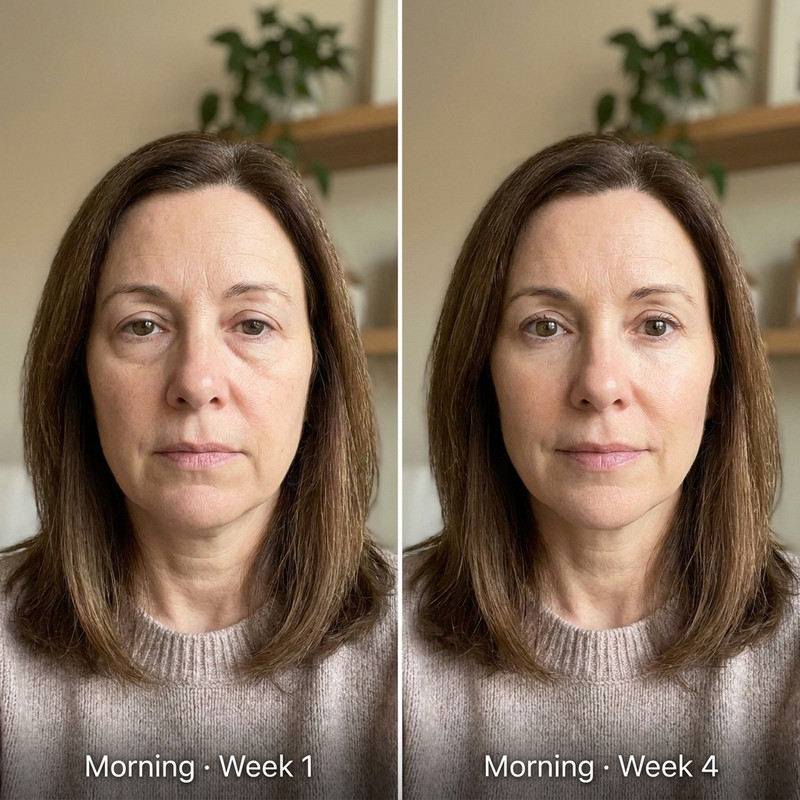
“I’ll be honest, I thought this was more wellness nonsense — I’m 53 and I’ve wasted money on worse, and I almost didn’t finish the first bottle. By the third week my face wasn’t as swollen in the mornings, and by evening I wasn’t as puffy as I used to be. It’s not a miracle and it took a few weeks. I just feel more like myself.”— Paula K., 53, Spokane WA · after 3 weeks
“What got me was the bathroom thing the first few days, which I now know is the whole point. About three weeks in I’ve got more jawline back than I did — I actually double-checked in the mirror like a weirdo. My husband still hasn’t noticed, which, classic.”— Renata G., 54, Tucson AZ · about 3 weeks in
“I used to feel heavy and bloated after dinner most nights. Now my evenings feel lighter than my mornings used to, which is a strange sentence to type. I take it in my tea. The only thing I’d change is I wish it came in a bigger bottle.”— Diana M., 51, Columbus OH · about a month in
What shows up in every honest version of this isn’t a number on a scale. It’s a jaw coming back, an evening that feels lighter, a face that looks awake again. That was always the point — it was never about the scale.
A few honest questions before you decide
“Isn’t lymphatic drainage just more woo?”
Fair — the category is full of it, and one woman summed up the whole internet when she said, “I really thought lymphatic drainage was just more woo social media was serving me.” Here’s what makes this one different from a feeling: four named herbs, each at a dose printed on a label you can actually read, and no twenty-six-ingredient smokescreen to hide behind. You don’t have to take the category on faith. Read the four herbs, read the doses, and decide for yourself — that’s the whole point.
“How do I know it’s not snake oil?”
Start with what a scam actually looks like. The reviews that scream “fraud” are the ones with a blurred label and words you can’t make out — “so you know it’s a scam,” as one woman put it. This is the opposite of that: four herbs named in plain print, nothing buried. And then there’s the part no scam will ever offer you — you finish the whole bottle over 60 days, and if you’re not lighter and less puffy, you email them, they refund every cent, and you keep the bottle. A company running a con doesn’t let you walk away with the product and your money. They’d rather lose the sale than have you feel stupid for hoping one more time. You’re not betting your dignity here. They are.
The 60-day “keep the bottle” guarantee
We’re betting on ourselves — not asking you to bet on us.
Use it every day for 60 days. Finish the whole bottle. If you don’t feel lighter and less puffy — if your rings aren’t sliding on a little easier — email us and we’ll refund every cent. You don’t even have to send the empty bottle back.
We’d rather lose a sale than have you feel stupid for hoping one more time.
“Will it really make me pee more?”
Yes — especially the first few days. One review just said it flat out: “Will make you pee! Be prepared.” But read that as the tide going back out, not a side effect to dread; it’s the most visible sign the drainage is moving again. If it leaves you feeling a little wrung out, a daily mineral top-up sorts it. Nothing to fix — just something to know going in.
“What about the red clover?”
Red clover contains natural plant estrogens — it’s the herb that speaks to the hormonal side of the stall, and it’s exactly why we say this plainly instead of burying it: if you’re pregnant, nursing, have a hormone-sensitive condition, or take medication, talk to your doctor before starting. That’s not us hedging. That’s us telling you the one thing a discount-bin label would leave off — so you can decide with your eyes open.
“$44 for four herbs?”
Most women here will tell you they’ve already spent more than that on creams, socks, and cleanses that did nothing — one counted “$1,300” she couldn’t keep up “until the end of time.” It’s the same price range as the leading brand; the difference is where the money went — real doses and a clean label instead of a discount-bin look. You’re not paying more. You’re paying for the part that actually has to be there.
Give the tide one season.
You’ve spent enough mornings bracing for the mirror. The body that changed at fifty wasn’t your fault — it was a tide that went slack when your estrogen dropped, and that’s the kind of thing you can start moving again. Four herbs, real doses, honey-sweet, made for the woman who doesn’t quite recognize herself since fifty.
And here’s the only bet on the table: you finish the bottle, and if nothing shifts, you keep it and get every cent back. That isn’t a marketing line — it’s the most a company can put on the table to say it believes its own product. The risk isn’t yours anymore. It’s theirs.
One honest note on supply: because it’s four herbs at real doses, it’s bottled in small batches — far less at a time than a twenty-six-herb factory blend. If you want the 90-Day Drainage Reset — the way most women here start, since a stall rebuilds over a season, not a weekend — that’s the one to reach for first.
Start Moving Your Tide Again →Backed by the 60-day, finish-the-bottle, keep-it-anyway guarantee.